Showing posts with label In Garthe's Hands. Show all posts

Thursday, November 08, 2007

In Garthe's Hands #16

November 9, 2007


In Garthe's Hands #16


I return this week to more hands that it may be a while before you ever get to see in the field. You may wonder why you should even bother remembering such hands if the possibility of finishing them is really so small. Indeed, they may not get finished often, but they will still have an impact, even when they aren't finished. The reason is that they tend to be nearly impossible to finished concealed; after a couple bumps, everyone already has a pretty good idea of where the hand is headed and will be very careful with tiles that are likely to finish the hand. I give to you All Terminals and its little brother All Terminals and Honors.


Let's begin with the Limit hand, All Terminals. That's right, limit means it's another hand that will get you the most points possible if you can finish it. The name says it all: the hand is entirely made up of terminals, meaning, 1's and 9's. Because there are only 6 of these types of tiles, a 1 and a 9 in each of the three suits, this hand can only be finished as 4 triples plus the head. Because of the extreme unlikelihood of being able to draw 13 of the 24 available tiles yourself, bumping tiles is allowed. However, bumping twice will make everyone pretty suspcious, and after a third bump, you're not likely to see anyone dropping a 1 or 9 for the rest of the hand. I have seen this hand finished a total of once and it wasn't even at the same table I was playing but the one behind me. I may have seen it ready once also so it is indeed another in the Extremely Rare category.


Because All 1's and 9's is so difficult, it's nice that it has a slightly easier version too: All Terminals and Honors. It's as easy to figure out from it's name as it's big brother, it's entirely made up of 1's, 9's and honor tiles. It will also generally be in the all triples shape though because there are is a total of 13 types of tiles to use, 7 Pairs will also be a possibility. This hand is actually only worth 2 points but because it will also always contain at least one other 2 point hand (All pairs or All triples) it is essentially worth 4 points. It is similar to Little Dragons in this respect. This hand is also fairly rare for similar reasons. Generally at least 2 triples will need to be bumped and as soon as that happens, everyone becomes much more careful with the remaining 1's 9's and honor tiles. But it can become a monster if a couple of the groups are Value tiles, one of the groups is Lucky dragons, it's a half flush, or all of the above. Try giving it a shot when any of those situations are near, or if the Limit hand seems to have become impossible.


Here are some examples:


All Terminals


Limit hand so it's 16000 points from each player if the dealer won, 8000/16000 if drawn by a non-dealer

All Terminals and Honors


We have Red and White dragons, Half flush, All triples and All Terminals and Honors for a total of 24000 if the dealer won, or 16000 if it was won by a non-dealer

And one question:


1-dots was the lucky dragon (dora). The dealer drew the winning tile himself. It's the first hand of the east round. How many points did he get?

Friday, September 21, 2007

In Garthe's Hands #15

September 22, 2007


In Garthe's Hands #15


Had a hard time deciding where to put today's column. It was originally just a response to Gemma's column, but then it was getting so long, it seemed like it might just be better to put it in with the columns. Hope I'm not stealing any of your thunder there, Gemma.

So the topic of course, is the All Pairs hand. I have certainly shared Gemma's frustration with it and have complained about its orneriness (ornerity? ornerosity?) quite a bit myself. To review, it's one of only 2 hands in Reach Mahjong which will not be of the normal form: 4 groups of 3 (runs or triples), plus a "head" or pair. This is one of the reasons that it's difficult to see when players are aiming for it and makes it something of a wild card in the Mahjong group of hands. A completed hand will simply be 7 pairs of different tiles. When I say different, I mean that it is unacceptable for 2 of the pairs to be the same tiles, in essence, a concealed quad remaining hidden in your hand. Personally I find this restriction a bit arbitrary and lame, but there it is. Here is an example of a finished hand:


It is surprising how hard it is to complete this hand despite how close one may seem in the beginning. I'll start thinking about it as a possibility with even just 2 or 3 pairs if a lot of the singles I have are outside or honors. And the road to 4 or 5 pairs is often very short. It's that 6th pair to make the hand ready, and the final tile to win that are the real problems. I'll always be waiting for something to match a tile already in the hand so at best I have 3 possibilities for each one of those singles. Let's think about it in terms of how many tiles are available and maybe it will become clear why these last tiles are such big hurdles. If I had just a Peace hand that was one away from ready with two open ended waits, there would be 16 possible tiles that make the hand ready. When my All Pairs hand is one away from ready, I'll have 3 singles waiting to pair up meaning that at best, there are only 9 tiles that could possibly make the hand ready. When I get to ready, that Peace hand is going to have 8 possible tiles for the win and the All Pairs will only have 3. (Of course these numbers will be affected by what's already out on the board but for this situation let's just think of the optimal numbers) So from the get go we know that All Pairs is going to be a harder than normal hand to complete.

So the now the issue: how best to work it into your game. If it's going to be a harder hand to complete, the reward for completing it should be greater too right? How to make it pay off? The most important thing is going to be finding the right tile to wait on, but let's start with one of the other decisions you'll have to make first, namely whether to go for All Triples or All Pairs. Factors affecting this decision will be what kind of pairs are already in the hand, if any of them are triples already, and whether any of them are Lucky Dragons (dora). If I already have 4 pairs with one of the pairs being lucky dragons, I'm going to be a lot more proactive about winning the hand, probably bumping (ponning) tiles the first chance I get and sending myself off in the All Triples direction. If my pairs are more towards the middle, I might consider the fact that other people are probably going to be using those tiles and no matter how long I wait, I may never have a chance to bump them. I tend to dream big, so as soon as one of my pairs becomes a triple, I'm already starting to think about 3 or even 4 Concealed Triples. That silly dream is why I personally end up going for All pairs more because I opt not to bump tiles when they first come out, hoping that I'll draw the last remaining one for the chance at the limit hand. Another big benefit of keeping my hand concealed is that I can Reach when it's ready, and in most games, Reaching allows me a chance at the Hidden Lucky Dragon (Ura-dora) too. My little 1600 pointer can turn into 8000 pretty quickly with a lucky turn there or even become 12000 if I manage to draw it myself. Lots of points to think about and we still haven't even gotten to putting the hand together yet.

So let's say the decision has been made to go for All Pairs. Now we want tiles in our hand that other people are not likely to be using: honors and the end tiles and especially, tiles on the outer side of pairs in our hand. In Reach Mahjong there is a defensive term called a "wall". a “wall” is when all 4 of one tile towards the end (2s, 3s, 7s and 8s) are showing, making the end tiles (1s, 2s, 8s and 9s) unusable in runs and also seemingly safe to discard. This concept of a "wall" is very useful in many situations, one of which being here, when we want tiles that other people can't use. For example, if we have a 3 of dots pair in our hand and can see another 1or 2 of them on the board, we know it's going to be difficult for other players to use the 1 and 2 of dots. We can more reasonably expect those tiles to come out or possibly still be in the deck if they're not already out on the board. Also, when things get dangerous because someone has Reached or someone may be quietly Ready to win without Reaching, these tiles will be useful as safe discards.

Finally when we have to decide on our "wait", there are two things to think about. First, same as before, we want to choose something that people are not likely to be using. Second, especially if we decide to Reach, it may be useful to set a trap. Not only is the 1 of dots probably a good wait anyway, but it looks especially safe to other players if there is a 4 of dots in our discards. Remember the Missed Win Rule (Sacred Discard) prohibits winning not only on a tile that we've already discarded, but also on any tile if any of the winning tiles has been discarded. Because players tend to aim for open-ended waits, any tile 3 above or below a tile in our discards will look a little safer to players looking for something safe to discard. So another example would be choosing to wait on the 8 of bamboos because we have a 5 of bamboos in our discards. This defensive concept is called Piano Keys. The idea is, opened ended waits always consist of a combination of 1-4-7, 2-5-8 or 3-6-9, meaning that a 4, 5 or 6 in a player’s discard makes 1 and 7, 2 and 8 or 3 and 9, seem safe, respectively.

As always, working more Hand points into a hand is the best way to make it really pay off. However, a lot of the standard "extra" hands won't be an option with All Pairs. Obviously, anything using runs or triples is out. Sometimes All Simples will be an option, but I tend not to aim for it because middle tiles tend to be more useful for other players. Remember, we want tiles that are NOT useful for other players. Also, a bunch of middle tiles are probably just going to end up falling into runs and it'll be easier to make it a pay off with a Reach/Simples/Peace combination. A Half Flush combined with All Pairs also seems to often come close but it's much harder than it looks to finish. Usually, something will pair up in another suit, and then that has to be discarded, but then everyone notices that a pair of something came out of my hand and then NO one discards anything from the suit not in my discards. So the best way for me to get lots of points out of it tends to be saving those garbage tiles that nobody wants and trying to make one of the pairs the Lucky Dragon (dora).

Looking at my stats on Mahjong Fight Club (Konami), it's definitely in the a-little-short-of-major category, occurring with slightly less frequency than 3 Colored Runs. If you find you go several games without finishing this hand once, you shouldn't actually find that too surprising. However it is harder for other players to read and it's possible for it to turn into a monster with a little luck so you should try working it into your game. The opportunities will come.

Let's get people's opinions. What would you do in the following situations and why?

South seat, 3rd hand of East round, 3000 points out of first place, 5th draw, Lucky Dragon (dora) is 9 of Dots


East Seat, 4th hand of South round, 4000 points out of first place, 5th draw, Lucky dragon (dora) is 8 of Bams
West seat discards 4-Grands(Cracks)


East seat, 3rd hand of East round, even with Dealer in first place, 5th draw, Lucky dragon (dora) is 6 of Dots
North Seat discards the first Red Dragon


Remember, no right or wrong answers so give em a shot.

Thursday, August 02, 2007

In Garthe's Hands #14

August 2, 2007


In Garthe's Hands #14


A little tired of reading about hands that you can only dream about? Well before we finish our tour of Fantasy Island (That would be the group of Limit Hands), how about if we return to a hand you'll see almost every other hand or so, Peace. There's a disturbing lack of it in the world today. But at least we can click our tiles together and make a little of it at the Mahjong table. It's second only to Reach and maybe Value tiles, at least in my statistics, so it's definitely something to think about working into your game.


To review, Peace (Pinfu in Japanese) is one of the simplest hands with the most complications. At its simplest, it's just a hand made up of 4 runs and a pair. Then there are the requirements. First remember that the head must not be value tiles. So the dragons will never be part of a Peace hand, and you also won't be able to use the Prevailing Wind tile or your current seat Wind. Next, your wait must be to complete a run and it must be open ended. That means that 12 waiting for the 3, or 57 waiting for the 6 would be unacceptable whereas 23 waiting for the 1 or 4 would be OK; also, a wait such as 5543 waiting for the 5 or 2 would be OK even though you might think of the 543 run as already being complete if another 5 came. In fact, 5554 waiting for the 3, 4 or 6 would also be OK for Peace as long as the tile that completed the hand was the 3 or 6 so it completes the final run. Similary 3456 waiting for the 3 or 6 would NOT be acceptable because the final tile is not completing a run; it's completing the head.


Why these inane complications for a concept so simple you may ask? Well Jenn just revealed the answer to this mystery to me last week! Peace is the only hand in Reach Mahjong worth 20 base points. Alright, the thing is, EVERY hand in this game is worth 20 base points, but every other hand will get some base points added on for triples, bad waits, or using value tiles in the head. Requiring the hand to have no value tiles, a good wait, and the fact that there are no triples means that there will be no extra base points (except of course for Self Draw. This does seem like a point that some nit picker some where would have said precludes Peace from being self-drawn. The Japanese are nothing if not rule adherers. Any comment on this exception Jenn?) So lest you think these are just arbitrary obfuscations designed to confuse the newbies, think again!! I don't doubt Mahjong's desire to confuse the newbies, but there is some reason to the madness.


On to the next subject, putting your Peace hand together. There are a only a million and one combinations that could become your next Peace hand, but let's look at a situation that has come up a lot recently in my hands and that I used to play differently. Let's say I'm one away from ready with a hand like this:


and I draw the 4 of grands; what should I do? I think my first inclination a few years ago I think was to throw the 7 so I now have the two open-ended waits. This is the best option for giving me the most possible tiles to make my hand ready. Any of the 3456 of Grands or the 2345 of Bamboos all make my hand ready. There are certainly situations where this would be the best way to go, for example close to the end of a hand where I just want to get my hand to ready but I'm not necessarily going for the win. The problem is that 16 of the 28 tiles that make me ready complete a run and force me to discard a tile from the unfinished run; I'll be waiting for a single tile to complete my head and that's NOT Peaceful! But there is another way. I can now switch horses in midstream and make the two 7 grands my head and still have the two open-ended waits. I do lose the possibility of being ready on 12 tiles, but in exchange, I have the guarantee that I will at least have Peace in my hand if I draw something that makes me ready. In this situation, it also gives me a better chance of getting Simples too if draw the 6 of dots and exchange it with the 9. This dilemma comes up surprisingly often, fastest-to-ready versus good-wait, and always makes for spirited arguments between me and Jenn.


Instead of scoring examples, let's look at some hands and see if we can get some people's opinions on what they might discard if they were in the given situations. There won't always be clearly right answers here so maybe add a little explanation for why you chose that tile to discard and then we can all call each other crazy appropriately.


Round: South-4
Seat: North
Lucky Dragon: 1-Bamboos
We have the most points. It's the 6th draw of the hand


Round: East-1
Seat: East
Lucky Dragon: 8-Grands
Our turn as dealer on the 5th draw of the hand


Round: South-3
Seat: South
Lucky Dragon: North-Wind
3000 points out of 1st place on the 12th draw of the hand

Thursday, July 05, 2007

In Garthe's Hands #13

July 6, 2007


In Garthe's Hands #13


Let's have some fun today. Well, dream a little anyway. I've covered nearly all the hands in Reach Mahjong at least once now and that includes the vast majority of the hands that you will ever see in your Mahjong careers even if you should decide to play 20 hours a day for the next 10 years. Limit hands are like Straight Flushes in Poker: they only happen once every few thousand hands or so (OK, I picked that number out of a nether area, anyone have an exact number?), but they're still fun to think about and even go for when opportnity knocks. Taking a look at my Fight Club statistics, the only sort of extensive statistics I have, I've played 359 "Competition Rules" games which probably average around 10-12 hands per game for a total of around say 4000 hands; in all of that, I have a grand total of 3 limit hands, Big Dragons twice and 4 Concealed Triples once. I've played 1501 East Round games which probably average between 5 and 6 hands per game and in that total of say 8000 hands again there are only 3 Limit hands, this time all 13 Orphans. So those 3 are the types of limit hands that actually do come out on occasion. Today, I figured I'd introduce a few so rare I've never actually even seen them: 9 Treasures, All Green, and Big Wheels.


9 Treasures: Limit Hand


9 Treasures is known as Chu-ren-poh-toh in Japanese and it's so rare that it's rumored to be a harbinger of impending death. It's like a Full Flush except that specific tiles are required for it to qualify. The winning combination will be 1112345678999 and one more of any of them. The thing that makes this hand so devilishly impossible as that it must be concealed. (Sidenote: you may notice that if you miraculously get to ready with the very combination above, it's a dream 9 tile wait and this will be a double limit hand in places that allow such things.) And to make it more confoundingly impossible, it's also the kind of hand which falls into the Missed Win trap when unneeded tiles come and complete a normal Full Flush hand but not this special flush. Or before Missed win even becomes an issue, sometimes after 5 or 6 draws in a hand, I'll notice I'm only a few tiles away with a combination like 1112356779 and then check the board and notice that there are already 2 9's on the table so the chance for it is already past. It's the kind of hand that's fun to dream about and then come back down to earth and just go for the Full Flush with maybe a Full Straight for a few more points.
Not only have i never seen it finished, I've only ever seen it ready a total of one time also. And of course that one time it was a victim of the Missed Win, though not maybe for the usual reasons. My starting tiles in that hand were a lot of 1's and 9's with a 123 of grands in there also leading me to believe it would be a good chance to go for an outside hand so my first discard was the 6 of Grands. But before I could really get started, some jerk called Reach on about the 4th draw, and it just seemed best to give up the hand. As he kept drawing and not winning I was was happily discarding the Dots and Bamboos that he kept throwing away. Without noticing, I was collecting a lot of Grands and around the 11th round I looked down to see quite a few Grands. Sure enough, after putting things in order I had 1112345777899 and some blank to be one away from ready. The 9 came on the next draw but what should my wait be but that "#$!$%&#" 6 of Grands I had thrown on the first draw. The hand ended without anyone winning, and I got all kinds of advice on how better I might have played the hand. Well, maybe that's why I wasn't struck by lightning and am still here today.


All Green: Limit Hand


Next let's look at All Green. It's another one requiring a very specific bunch of tiles which is what makes it so rare and also so prone to Missed Win woes. It's called Ryu-i-sou in Japanese and both names mean what they say, the hand only contains tiles that are entirely green. Those would be the Green Dragons (Hatsu) and the 23468 of Bamboos. I must admit I was a little slow in noticing this, but it's true, 1579 of bamboos do have a bit of red on them which is why they don't get to be a part of ALL Green. In fact, with the Green Dragon being nicknamed "a-o" (pronounced "ow") which means blue in Japanese, sometimes I wonder why it gets to be included. There's a weird confusion of blue and green in this country: traffic lights are allegedly red yellow and blue; "blue onions" are green, fruit that's not ripe is "blue"; but maybe that's a discussion for another website. Anyway, some rules will allow All Green without any Green Dragons but most rules require at least 2 for a head though a triple is acceptable also. The remaining groups can be any pair run or triple of 23468 of Bamboos. Of course, runs will only be possible with the 234 and this is where Missed Win rears its ugly head again. Once again, the one time that I've seen someone get this hand to ready, he also had fallen victim by throwing away a 5 when his wait was the 2-5 of bamboos. Because of that 5 his winning 2 was discarded twice but he couldn't win on them because he had discarded one of his winners. This hand is the only one I'm introducing today that doesn't need to be concealed, but somehow that doesn't seem to make it occur any more reguarly. Once again, stories about it tend to be fish tales about the one that got away.


Big Wheels: Limit Hand


Finally we have Big Wheels. It's called Dai-sha-rin in Japanese, and it rounds out today's frivolity by being so rare as to not even be included in most rules. I write about it because a lot of home games do like to include it though it occurs even less often than the other 2 I talked about today. It's a pair each of the 2 through 8 of dots and in keeping with the theme of impossibility, it must be concealed. Also in keeping with today's theme, because it's all one suit like the others, it shares the same tendency towards Missed Win discontent. It's almost not necessary to make it a limit hand because as is, it's probably almost already that many points anyway. Consider that Concealed Full Flush, 2 Double Runs and Simples are guaranteed to be part of the hand with also a possibility of Peace, Reach, Concealed Self Draw and even Lucky Drags. 13 hand points would make it a "Counted Limit Hand" but I'll leave that as the subject for another frivolous column.


You may notice that all of today's hands are some variation on the flush theme. I've heard that these hands used to be divided along suit lines, i.e., 9 Gates had to be Grands, Big Wheels had to be Dots, and All Green had to be Bamboos. I'm just guessing but given the ludicrous impossibility of Big Wheels, somewhere along the line people may have decided to just go with the only ridiculous impossibility of 9 Treasures and changed it so that it was acceptable in any suit. All Green's name was just too suit specific to allow it to use other suits however. They're stilll fairly valuable hands even if one goes for the cheaper options, Full or Half Flushes. In most cases though, I imagine it'll be fun to try going for the glory for a few draws until it becomes obvious that cheaper is the only option. Just like in Poker, it's more fun to win with a Straight Flush and it makes a better story, but a simple straight may get the job done just as well. But every thousand hands or so.....let's look at some examples.


9 Treasures


It's a limit hand!! That means 32,000 points or 48,000 for the dealer. Of course, there are other winning tiles here. Can anyone take a shot at guessing the other winners and how much they'd score?


All Green


Once again, a limit hand!! No computation necessary, 32,000 points or 48,000 for the dealer. Here again the wait is tricky. Both the 2 and 8 still qualify as limit hands but winning on the 5 would just make it a Half Flush and Value Tile hand for a total of 3 hand points and 3900 points or 5800 for the dealer.


Big Wheels


A limit hand is a limit hand, 32,000 or 48,000 for the dealer. Even in situations where this is not allowed as a limit hand, it's still a knee slapper. Anyone want to take a shot at scoring it regularly? Just a little hint: I seperated the tiles that way to confuse you.

Saturday, June 02, 2007

In Garthe's Hands #12

June 2, 2007


In Garthe's Hands #12


We have a request!! One faithful reader has expressed an interest in hands that are not "hands". Most of the hands I've covered so far involve some specific combination of triples and runs. However, some of the hands are situational, the triples and runs are not as important as what has the current situation in the game. I've covered a couple such hands so far, Reach and Concealed Self Draw. Remember, in both of these hands, the combination of runs and triples in the hand is not important, the hand must simply be "ready". One might consider these hands that are not "hands" because there's no specific combination necessary. There are several such hands but aside from the two mentioned above, they are comparatively rare. This week I'll cover 3 of the more unusual ones, Final Tile Win, King's Tile Draw (Quad Heaven Draw), and Add-a-Quad Win.


Final Tile Win: 1 Hand Point


Of the 3 hands this week Final Tile Win will probably be the most common (Haitei in Japanese). It is sometimes divided into two categories: Final Draw and Final Discard. Like Reach, the only requirement of the contents of the hand is that it be "Ready". The situation is that it is the last tile of the hand. This means that if the last tile drawn completes that player's hand, he can declare Mahjong, even if he didn't have any other Hand Points in the hand (Final Draw). Even if that last player to draw doesn't complete his hand, the last tile he now throws away is just as important. If that tile complete's one of the other players' hands then that player can now go out, even if he didn't have any other Hand Points in his hand up until that point (Final Discard). Of course, it will work together in the usual way with other hands to make for a multi-point hand if there are other points in the hand. Also, players will sometimes steal tiles toward the end of a hand to make their hands ready in case that hand ends in a draw. It can be a nice extra bonus to win on the Last Tile even though one was only going for the ready hand points.


A key point to be careful of with Last Tile is to not run afoul of the Missed Win rule. When that last player discarding is looking for something to throw away, he will often choose something related to a tile that was just discarded. For example, let's say I'm waiting for the 6-9 of dots with a ready hand that doesn't have any Hand Points in it yet. The second to last player discards my 6 of dots but I can't win on it because I haven't Reached, and I don't have any other points in my hand. Because he has just thrown the 6, the last discarder knows that it's a safe tile and unfortunately for me when he throws it, I still can't go out because I am now on a Missed Win. In fact, even if he had thrown the 9, my wait still leaves me subject to the Missed Win rule and would not be able to win on that tile either. Never forget the treachery of the Missed Win; it killed me more than a few times in my early days. Last Tile is unusual, but it's also a cool way to turn what might have been only 1000 points for a ready hand, into a few more for a winning hand.


King's Tile Draw (Quad Heaven Draw): 1 Hand Point


Next let's look at the Quad Heaven Draw. Once again, the only requirement for the hand's contents is that it be Ready. The situation is that a player has just completed a quad and the extra tile drawn from "Heaven" completes his hand. It's fairly simple actually, but some parlors have a special rule regarding this situation that I really REALLY hate, mostly I suppose, because I'm the only person I know to have ever been hit by it. If the player draws the tile to complete his quad himself, then it won't be an issue; the other 3 players will split the points to paid to the winner in the normal manner. However, if I throw the tile that completes a player's quad and the supplement tile that he draws from the King's Tiles is his winning tile, I am "Responsible", and I must pay the entire amount, even though I didn't throw his winning tile. It really ires me not only because I don't see why I should be paying when I didn't throw his winner, but it also takes precedence over the Missed Win rule which is usually one of the most sacred parts of Reach Mahjong. That player had actually thrown away one of his winning tiles and then drew it from Heaven and then I have to pay?!?!?!?!?!?! !"#$%&$%&'%&'($&'"#$%"%&$()%' Graceful loser that I am I may have lost some face with the staff on that one.


A note from Jenn: The reasoning behind this "Pow" or "Responsibility" rule (also seen in some Limit Hands) is that if you discard a tile that allows another player to declare a Quad, it means you threw a tile that has not yet been seen on the board and you should have an idea that it is quite dangerous. I'm not sure how I feel about this rule either, but there does seem to be some rhyme behind it.


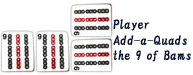
Add-a-Quad Win (Robbing the Quad): 1 Hand Point


And last for this week will be the Add-a-Quad Win. Rarer in fact than some of the limit hands I wouldn't be surprised if many readers never get a chance to see it. The situation required here is that a player has bumped some triple and then draws the 4th of that tile to complete the quad. If he adds the tile to make his quad, and that tile completes another player's ready hand that player wins; the player making the quad must pay the winner. In general, concealed quads are exempt, though there is one situation where one can win even when the quad is concealed. When the winning hand is 13 Orphans, most parlors and home rules allow a win even when the quad is entirely self-drawn or concealed.


Because these hands involve situations and not combinations, it will be difficult to make very illustrative examples. But it just feels so empty without examples so let me go ahead and try anway:


Final Draw


The last tile drawn from the mountain was the 2 of Bams so the hand has Concealed Self Draw and Final Draw for a total of 500/1000 if it's non-dealer, or 1000 from each player if the winner is the dealer.

Final Discard


The player drawing the last tile from the mountain discarded the 8 of Bams and 9 of Dots was the Lucky dragon so the total is 2000 for a non dealer or 2900 if the winner is the dealer.

King's Tile Win


The 1 of Bams was the Lucky dragon so the player bumped hoping to get an outside hand. Unfortunately the 6 of Grands came so he was hoping to draw a 九 so he could change it to an outside hand but when the 9 of Dots came out, he quadded hoping to get lucky and he did!!! After quadding, he drew the matching tile for his head and gets one point for the King's Tile Draw and 3 more for the Lucky Dragons for a total of 4 hand points. That's 8000 for a non-dealer or 12000 for a dealer.

Add-a-Quad Win


A player had already bumped the 9 of Bams and when he drew the last 9 of Bams and added to the other 3 to make a quad, this hand won. Peace, 3 Colored Runs (concealed) and Quad Heaven Draw for 7700 points for a non-dealer or 11600 for the dealer.

Sunday, May 06, 2007

In Garthe's Hands #11

May 6, 2007


In Garthe's Hands #11


Today I think I'll write a letter to myself. We've covered a lot of hands so far. There are only about 10 or so I haven't told you about yet, and for the most part, they will probably not figure largely in your Mahjong careers. So today in light of some recent events, I thought I'd review a couple hands that are comparatively rare but will still be relevant to your Mahjong conquering dreams. At least, one would have been relevant to my dreams had it come to mind at the right moment. How about another look at the two outside hands using some recent real life examples.


Let's begin with the Pure Outside hand, known as "Junchan" in Japanese. Every group must contain a 1 or 9, meaning that only triples of 1's and 9's, and runs beginning with 1 or ending with 9 will be in the hand. It will never contain any honor tiles, and will not use the numbers 4, 5 or 6 in any suit. It is 3 hand points when concealed, and 2 hand points when tiles are bumped or chowed. This is a fairly difficult hand to put together so parts of it will often be exposed like in today's example. There are many ways to make this into a high scoring hand, but today's is one that might not have occurred to a lot of players. It's also a good example of how remaining flexible throughout the hand can help you change course and still pull off a nice winner when you run aground on your first course.


My friend's starting tiles and first draw looked about like this:


It's not a great starting hand, and with 9 different outside tiles, it actually qualifies as a hand that you can say "I give up" and make everyone start the hand over. My friends however, ever the dreamers, never give up a chance at a limit hand, and so off this guy went on a quest for 13 Orphans. After 7 or 8 draws, he had only managed to exchange a couple of the middle tiles and was not any closer at all to assembling the orphans, especially after I'd bumped 3 of the White Dragons. His hand now looked like this:


This hardly looks promising, but 1 of Dots was the Lucky Dragon and when the player in front him threw 8 of Grands he suddenly chowed and decided to go for an Outside hand. Next he drew 8 of Dots and with more cooperation from the player before, he chowed 7 of Dots from him and was now only one away from ready. That player next called Reach, discarding the Lucky Dragon which our hero bumped, and what was his next draw but his winning 7! His winning hand:


Pure Outside Hand(exposed), 3 colored runs (exposed) and 3 Lucky Dragons, was good for 12,000 points. Sure it was a lucky crazy move, but then that's what these games are, putting yourself in a position to get lucky.


Next let's look at an example where I put myself in fantastic position to get lucky and blew it with Mixed Outside hand. To review, this hand is like the Pure Outside hand except that it allows the use of Honor tiles. Concealed it's 2 points but exposed it will be worth just 1. I had had a pretty tough first 3 games at Masters last Saturday and needed a big win in the final game if I wanted to continue onto the next round. We were getting toward the end of the South round of the final game and my last turn as dealer had just been stolen on a 1000 point hand. A little despondent, I felt more like disrupting everyone else's game at that point than trying to win. I started with:


and bumped the White Dragon my first chance when it came out first round. The next round someone threw the South Wind and right away things are starting to look interesting, especially when I draw the West Wind to make a Head. Now I'm now only one tile away from completing this Half Flush hand with two Value tiles, that's 8000 points and gives me a shot at finishing the day in the black and going on to the next round. At some point here, it would have been good for me to notice that the hand also included the Mixed Outside hand, even though for the moment, the five hand points still only make it an 8000 point hand. The defining moment was when the player before me reached and I drew the last South Wind to make a quad. Not only was the "King's Tile" the 3 of Dots but it was also the "New Lucky Dragon" giving me one more point and bumping my hand up to 12,000 points. The Reacher threw my winner on his next draw but without thinking, I just said 8000 points and that missing 4000 would prove to be what kept me from advancing. I finished with -1900, and the cut off was -300.


So not only is an awful story because I didn't advance, but also I know all the guys I work with can't wait to start teasing me about how I could advance in tournaments if only I knew how to keep score. Add to that the fact that I threw an 18,000 point winner to one of the guys I work with when we happened to be at the same table, and the fact that I will undoubtedly make this very kind of mistake again, and....sigh. Well it's enough to drive a boy to Poker. So let Mixed Outside hand never be far from your mind, especially when it is the deciding 4000 points for whether or not you're advancing to the next round in the biggest Mahjong tournment of the year.

Saturday, April 14, 2007

In Garthe's Hands #10

April 15, 2007


In Garthe's Hands #10


Greetings from Vegas!! I'm working! And studying, compliments of Jenn, Kirk (poker buddy) and the rest of the Poker community at Bellagio and the MGM Grand. I have to say that in case any of you thought I was just out here fooling around. Unfortunately, work isn't paying so well this time around, but there are still some more work days ahead so we'll have to see. I'm always intrigued when I can make comparisons between ways to play things in Poker and Mahjong. I just hope all this Poker doesn't take me out of the zone when I'm playing Mahjong, I've been doing so well lately. Ha!


Last time I wrote, I promised the next hands you would see out of me would not be very useful, but maybe I'll put that off for another week. Before we delve into total obscurity, how about a couple hands that might actually still figure into your Mahjong futures? I've only given one column to limit hands so far so let me introduce another one that does come up sometimes along with its little brother.


Little Dragons: 4 Hand Points (2 for Little Dragons, 1 for each set of 3 Dragons)


Let's start off with Little Dragons. I've only seen it a few times, and have yet to see it on Fight Club, but when it hits, it can be a nice payoff. Called Shosangen in Japanese, it's worth two points whether or not any tiles have been bumped or chowed. One qualifies for this hand by getting 2 triples of any of the 3 Dragons and a head consisting of the third Dragon. The other two groups in the hand can be any runs or triples of any suit or honor tile. Because each of the Dragons will always count for a hand point, the hand will always be at least a 4 hand point hand. One of the ways to make it count for more is to mix in the Half Flush. This shouldn't be too difficult as more than half the hand is already given over to Honor tiles anyway. If the remaining two groups are the same suit or are honor tiles, it bumps the hand up to 6 hand points for a score of at least 12000/18000 points. However, the best way to get the most bang for your Dragon's buck is to go for this hand's big brother: Big Dragons.


Big Dragons: Limit Hand


The difference between Small Dragons and Big Dragons is all about one tile, but that one little tile makes all the difference in the world. While the Little version is just two of the triples, the Big version is triples of all three of the dragons. This is another limit hand (like 13 Orphans or 4 Concealed Triples) which means we'll get the most points possible no matter what else is in the hand, 32,000/48,000 points. Again, the remaining two groups can be any kind of run or triple. There's no restriction against bumping or chowing and indeed, it would be pretty difficult to assemble triples of all three dragons without at least one bump. And once that second Dragon has been bumped, suddenly everyone will be extremely wary of discarding any of the last remaining dragons. That last one will almost certainly need to be drawn though there are situations where it will sometimes come out, most notably when a player has reached and must discard anything that is not his winning (or a quad-able) tile. It is a sick feeling to have reached and then see someone bump the second dragon, especially if none of the third remaining dragons are on the table.


Because the Little version is so close to the large version, it's always a quandary deciding whether to go out on the cheap or go for the glory with the Big. It's not an issue if one has somehow managed to get to ready with triples of all three in the hand through bumping or even just drawing. However, the vast majority of the time, at least one or usually two of the dragons will have been bumped and our hero's ready hand will be waiting with two pairs, one of them being the last remaining dragon, and the other being some unrelated non-glorious nothing. If the nothing comes out first, what...do...you...do? Well, there are a lot of f>actors to consider: what everyone's scores are the moment, how early in the hand it is, whether or not someone has reached or stolen tiles so he seems close to going out, etc. Also sometimes people and Mahjong parlors play with an extra reward for finishing a limit hand, so that might also figure into the mix when deciding whether or not to continue trying for the limit hand even after a cheaper winning tile has come out. It's an extremely rare hand, of course, it's a limit hand! But it will spice up the game once in a while, even if someone only manages to finish with the Little version.

Here are some examples


Little Dragons ex.1


Let's say this is a river-win. Just the two value tiles (the White Dragon and Red Dragon), and Little Dragons for a total of 8000/12000 points. (Note that if the Blue Dragon was drawn or bumped, 8 of Dots or 9 of Dots could be discarded for a single tile wait and a chance at Big Dragons and a glorious earth shattering win)


Little Dragons ex.2


Blue Dragon, Red Dragon, Half Flush (concealed), 3 Concealed Triples, and Little Dragons for a total of 16000/24000 points


Big Dragons ex.1


Big Dragons, 32000/48000 points, no matter how you slice it. (You may notice that this hand is also actually a Mixed Outside hand, but it's already a limit hand so the point is MOOOOT)

Tuesday, March 20, 2007

In Garthe's Hands #9

March 20, 2007


In Garthe's Hands #9


Long time no hands!! I bet you all thought with the lack of new hands columns that I must have finally run out of new hands to throw at you. Not the case! Though it should be encouraging to know that we are at least half way through them all at this point. In fact, it should be even more encouraging to note that the 16 hands I've given you so far plus the two I'm going to give you today make up 3396 of the 3428 hands I've completed in 1544 games of Fight Club so far this year. That's more than 99%! So pay attention for at least this column too, and then you can ignore me in earnest for a few weeks. Without further ado, I introduce to you: One Suit Straight, and 3 Concealed Triples.


One Suit Straight (Full Straight): 1-2 Hand Points


One Suit Straight is called Ikkitsuukan in Japanese but it usually gets shortened to just “Ittsu”. It is three consecutive runs all in the same suit, plus another group which can be a triple or run, and a head, of any suit or Honor tile. Put another away, this hand must have a 1-2-3-4-5-6-7-8-9 all in the same suit. Concealed it's worth two points but stealing tiles will knock it down to one point. Like 3 Colored Runs or the Outside hands, this hand will generally be more useful when worked in with other hands, in this case, especially Peace, Reach, Concealed Self Draw and Full or Half Flush. Also like those hands, though unusual, there will be times when stealing tiles is advantageous, most likely when there are some lucky dragons in the hand but no hand point to be able to win with them. Also like 3 Colored Runs, it is often a bit of a crapshoot achieving the hand as usually, the wait will be for the final tile to finish the straight, and after reaching, one may have to win on the tile that does not complete the straight. Another thing that I find strange about this hand is the number of times I come to a crossroads where I must decide whether I'm going to go for this or 3 Colored Runs. An oddity I wonder if anyone else has ever noticed?


Three Concealed Triples: 2 Hand Points


Our other hand for today is 3 concealed triples. It's called Sananko in Japanese and if you remember the limit hand I introduced you to a few weeks ago, 4 Concealed Triples, the concept behind this hand shouldn't be too difficult; it's just one less triple. Just remember, like its big brother, the tiles that make up the triples must all be self drawn. That's the only limitation regarding stealing, so if a tile for the other group or the head (pair) come from another player, the hand is still worth the same 2 hand points, concealed or not. It's an unusual hand, but seems to come up in some interesting situations. First of all, it's one of the saving graces when going for 4 Concealed Triples but another player throws the winning tile before it can self drawn. In such a situation, the hand will at least contain All Triples and 3 Concealed Triples for 4 points making it still a hand worth going out on even though it wasn't the coveted Limit Hand. Another situation I find it useful is when I don't have any hand points in my hand but I do already have 2 triples and my wait is two pairs waiting for one to become a triple. If I Reach on this hand and someone throws my winner, I'll only have the Reach Hand point. If however, I manage to draw my own tile, suddenly I have Reach, Self Concealed Draw, and 3 Concealed Triples for a total of 4 points and another nice hand. These are the two major situations this hand will be useful, the others often being a bit of a boondoggle I find. One final point, when there are already 3 triples in the hand and the final group is a going to be a run, there are those who might reach and there might be a good argument for it, like it's the final hand and one only needs that number of points to win the game. However, in most situations, most players (well, us dreamers anyway) would prefer to wait for one of the tiles in the incomplete run to pair up so that the hand would be ready for 4 Concealed Triples. Dream dream dream.





So how about a few examples:


One Suit Straight ex.1


West was the lucky dragon so with the unconcealed One Suit Straight this would be 3900/5800 points

One Suit Straight ex.2


Let's say the player Reached and drew his tile himself and ① was the Lucky Dragon. Then the hand would be Reach, Peace, Concealed Self Draw, One Suit Straight and one Lucky Dragon for 12000/18000 points! As an aside, can anyone take a stab at what the winning tiles would be for this hand?


3 Concealed Triples ex.1


Let's say the player reached and somebody threw his winner (remember, if he had drawn it, he'd have hit 4 concealed triples, a limit hand!!) He gets Reach, Red Dragon, 4 triples, and 3 Concealed triples for 12000/18000 points.

3 Concealed Triples ex.2


Assume he reached and drew the 8 himself. He'd have Reach, Concealed Self Draw, and 3 concealed triples for 8000/12000 points.


So now that I've basically told you there's hardly any reason to read my column for the next few hands I bet you're wondering how I'm going to entice you to keep coming back? Great writing!! It goes without saying! Also, I too am interested in your comments, laments, and random stories regarding bad beats or people being catapulted over swimming pools into the adjoining neighbor's yard. Send any of the above to my e-mail.

Tuesday, February 27, 2007

In Garthe's Hands #8 - Outside Hands

February 27, 2007


In Garthe's Hands #8


How are you all holding up remembering all those hands? We've covered quite a few already and I wouldn't be surprised if some of you are wondering how much longer I can keep coming up with new hands to throw at you. Don't worry; after 14 of them now, we're almost halfway through! Hang in there. The hands I'll be covering the next few issues will be comparatively rare, but can make for impressive scores when they're pulled off. Today let's cover two more that are closely related to each other: Mixed Outside Hand, and Pure Outside Hand.


Mixed Outside Hand (Terminals and Honors): 1-2 Hand Points


A Mixed Outside Hand, known as "Chanta" in Japanese will be a hand consisting only of runs or triples and a head that use a 1, 9 or letter tile. It is a bit of a converse to Simples. So 9-9-9 in Bamboos would be a useful group, as would 1-2-3 in Grands. Pairs or triples of Honor tiles can also be used. Concealed, it's fairly rare so it's worth two Hand Points. Stealing tiles from discards will bump it down to one Hand Point. It's a good idea not to steal tiles without good reason. A couple of possible reasons might be; perhaps the tile is almost all gone, or, there are other Hand points in the hand too so it's an expensive hand and worth stealing for. One of the other hands that will often work in well with this hand is Three Color Runs. Because runs all have to be at one extreme or the other, it will often just work out that there's one in each suit. One of the reasons it's so unusual, at least for me, is that I drop stray 1 and 9 tiles early in the hand as a matter of course. At the beginning of a hand I may have 6-8-9 in a suit and discard the 9 without noticing that I have a lot of terminal tiles in all the suits. I've shot myself in the foot right on the starting line. So lately I do try to pay attention as I'm first grabbing all my tiles to see if I have a lot of the terminals and letter tiles. This is good for noticing whether or not you have a good shot at the All Terminals Limit hand too.


Pure Outside Hand (All Terminal Sets): 2-3 Hand Points


Pure Outside Hand is Mixed Outside Hand's big brother and you may be able to guess from the difference in the names that what makes it different is that it doesn't allow the use of Honor Tiles. So all groups and the head must contain a 1 or 9. This is considerably more difficult, so it's a 3 pointer. Though, once again, stealing tiles will knock it down a point to 2. And once again, Three Color Runs is even more likely with this hand as the kinds of groups get more concentrated without the letter tiles. And once again and again, it's one of those things that needs to be noticed early if there is to be any chance of going for it. The Japanese name for this hand is "Junchan".


One thing to note especially regarding these hands, is how bad an idea it might be sometimes to use Reach together with them. If the wait happens to be a "good" one, for example 23 waiting for the 1or 4, there is a huge risk of having to win on the wrong tile. Reaching and then letting the cheaper tile go by without winning will knock the hand into the "Missed hand" category and the only option for winning anymore will be drawing the winning tile. So a hand that might have been huge with 6 points may wilt all the way down to just one point for the Reach.


Here are some examples:


Mixed Outside Hand ex.1


Just 1000/1500 points. Useful perhaps at the end of the game if one just needed to win a hand to end the game.

Mixed Outside Hand ex.2


Let's say the player reached and some unlucky soul threw the red dragon: the hand points are Reach, Red Dragon, Triple Colored Runs, Terminal/letter groups for a total of six hand points making it 18,000/12,000 points!


Pure Outside Hand ex.1


Bumped because ⑨ was the lucky dragon, this would be a 12,000/8000 point hand

Pure Outside Hand ex. 2


This is an example of the situation where declaring Reach might have been disastrous. If the 4 had come, the hand would simply be Reach and Peace for a grand total of 2900/2000 points. The fact that the player waited quietly for the 1 to come out adds Triple Color Runs and Terminal Groups into the mix for an actually grand total of 18,000/12,000 points.


To post comments to this column, click here.

Thursday, February 15, 2007

In Garthe's Hands #7

February 16, 2007


In Garthe's Hands #7


Last week I got to tell you about my absolute favorite hand so I guess this week I have to go to the other extreme and tell you my most hated. It's strange because many pros consider it their favorite. I don't know if it's just because I want to be different or because I'm bitter or what, but this hand bites me more than it feeds me and I just can't forgive it. I HATE Sanshoku. I hate it so much I don't even want it to have an English name. How about 3 Color Runs. That sounds poopy enough doesn't it?


3 Colors (3 Color Run): 1-2 Hand Points


Does the name say it all (Sanshoku dou-jun in Japanese)? You qualify for this hand when you have the same run in all three suits, for example 234 in grands, 234 in dots, and 234 in bamboos. Concealed, it counts as two hand points but stealing tiles will knock it down to one point. I can't stand this hand because when I aim for it, invariably the wrong side of my wait comes and I am disappointed; for example, in the above situation I would perhaps already have the 234 in grands and dots and a 23 in bamboos waiting for 1 or 4 and what comes but the 1. I hate that. Another favorite trick the mahjong gods play on me is giving me, say, 345 grands, 235 dots and 45 bamboos. I have the possibility of the triple run but I have that lame wait in the dots. I generally take the good wait in that situation and after discarding the 5 of dots, of course the 4 always comes and if I go out on the hand someone always points to my discards and mentions what a shame it was that I didn't go for the big hand. God I hate that.


But I suppose rather than try to poison your minds on the folly that is 3 Color Runs, I should try to show how it might be useful and let you discover its orneriness yourself. This is another hand that will often combine well with other hands, mostly Reach, Peace, and Concealed Self Draw. All Simples will sometimes also work itself in there too. It's a little dangerous to steal tiles for this hand because like I pointed out above, what if the other side of the wait comes?!!? If one does decide to bump or chow aiming for this hand it's a good idea not to until it's a sure thing. i.e., either bumping the 3rd run, or the final wait is only one tile and not open-ended. There might be other reasons to try to steal tiles without it being certain yet, but they'd better be good. There's nothing worse than going for it, then drawing the wrong side of the wait, and having to wait for the winner as a "Missed Win.


3 Colors (3 Color Triples/Quads): 2 Hand Points


Having covered 3-Colors in the first half, let's now cover 3 Colors. Lest you think I'm hitting the bottle again, let me explain, there are actually two kinds of these 3 color hands. The second one is "3 Color Triples", the first one was Runs. In Japanese, their names both start out with the word Sanshoku but the second word is different. In fact, the triples version is so rare, that the name Sanshoku has generally just come to mean the runs version, and if someone wants to talk about the triples version he'll use the full name, Sanshoku Doukou. I've probably only seen this hand 2 or 3 times in my Mahjong life so it's not likely to play large role in anyone else's life either. Its one advantage over the other version of 3 colors is that it is still worth 2 points even when tiles are stolen. This hand really only occurs by accident. The only time I might ever really decide to go for it actively would be if I happened to have at least 2 of the same number in each suit; I'd probably start bumping as soon as any of them came out. The times I've seen someone steal 2 suits of the same number, I've actually seen people throw number in the last suit a lot. I think some people really want to see someone win with this hand and are actually willing to help sometimes.


Let's look at some examples.


3 Color Runs ex.1


Just 1000/1500 points. Useful perhaps at the end of the game if one just needed to win a hand to end the game.


3 Color Runs ex.2


Let's say the player here Reached and drew his own winning tile; he would have Reach, Simples, Peace, Concealed Self Draw, and 3 Color Runs for 12,000/18,000 points!! Way to go!!


3 Color Runs ex.3


Let's say West was the Lucky Dragon, this would (usually) be worth 8,000/12,000 points. It's a nice pay off but it was a big risk hoping that the 1 would come and not the 4.


3 Color Triples/Quads ex.1


In this example, ⑤was the lucky dragon. The only hand points are the 2 from 3 Color Triples but because the triples were 1's this gets up to 5,200/7,700 points


3 Color Triples/Quads ex. 2


This hand has "4 Triples" and "3 Color Triples", 2 2-pointers; it scores 8,000/12,000 points