Sunday, August 12, 2007

Jenn's Corner #15: OEMC

August 12, 2007


Jenn's Corner #15: OEMC


I took my first trip to Europe, using the excuse that my sister was studying/interning in Italy and stopping in Copenhagen for the 2nd OEMC. This was the first tournament I ever attended that used the Chinese Official rules and also the first tournament I attended that offered no cash prizes for the winners. The organizers are all volunteering and this was amazing to me, coming from a
background where playing Mahjong for money is not only accepted, but considered to be the norm.


I knew this would be the first time that I would meet many people that I had been in contact with via e-mail for the past year (like Martin Rep and Tina Christensen) and some that I had heard of but never gathered the courage to contact (Tom Sloper) and some that I had met before for brief periods (Benjamin Boas). This was my first trip to a place I had never been where I knew no one. It took me forever to figure out how to get to my hotel and even longer to get over the fact that the internet wouldn't work and the place itself was much different (meaning worse) than the picture on the internet.


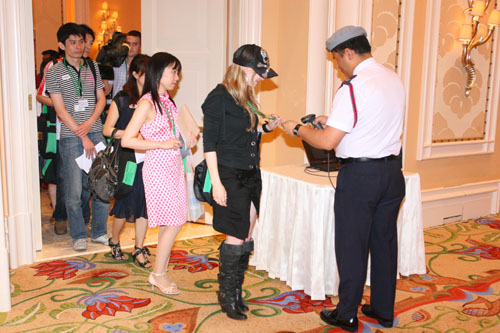
Somehow I found my way to the venue for registration. I waited outside and was greeted by the Taiwanese team! They had seen me on the news in Taiwan after my participation in the WSOM (Macau) and started speaking to me in Chinese (even though my interview had been in English). I took this opportunity to practice speaking a bit of Mandarin and make some very good friends from the place I used to live.


Although I wouldn’t be competing, I did have a package waiting for me as a companion. Walking in, I saw the legendary Tom Sloper. He was busy passing out his newly published book to those deserving but he managed to find time to greet me with, “So you’re the famous Jenn!” This coming from the famous Tom! I was surprised and very pleased that he knew who I was and we became fast friends. I also met the rest of Team USA and enjoyed my first Danish meal with some new friends from Austria and France. All I can say is why didn’t you tell me there was horseradish in it??


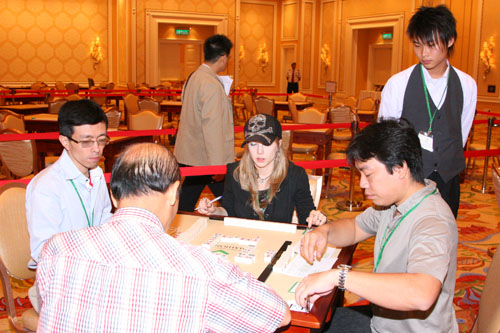
The famous Tom and the famous Jenn


One thing that surprised me in the opening comments was the emphasis that mahjong should not at all be associated with gambling. This is an opinion that I can never agree with. While I do not believe that all mahjong games must include gambling, I have a great appreciation for the fact that it is easy to incorporate a monetary incentive for winners. I have never considered gambling to be a bad thing and think of it as an important part of my life. To be quite honest, I get a little bit disappointed when people tell me that gambling is bad and should not be associated with the game I love since they are both such huge parts of my life, together and separately. I wonder if it would be something like telling a sommelier that alcohol is bad and not be allowed with meals? I guess I’d have to ask a sommelier... Can someone introduce me?


There were a few interesting occurrences, for instance, the player from Team Osaka that was caught with extra tiles in his lap. I have chosen not to comment extensively on this subject because it was not something I witnessed. I would, however, like to commend Mr. Oda, who continued playing on the 3rd day without a team for support and took 2nd place in the competition. Also, I was granted the honor to ring the gong on the final day. Very excited, I waited by the stage for my cue and when it was finally time, I rang it! But, oh no! I was too quiet! So this time, the gong was rung twice to commence the session. Everyone had a good laugh at my expense (including myself) and it made a great memory to tell all of you about.
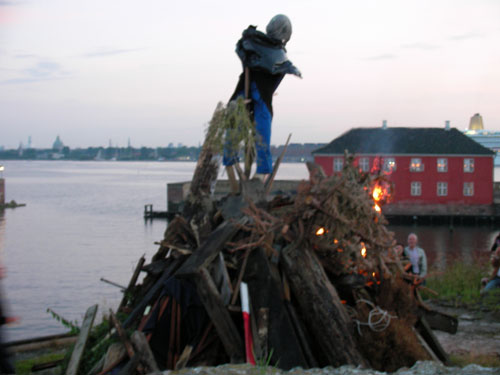


The witch at the bonfire


Those feelings aside, I enjoyed the entire event. I met amazing people, got to see my first witch burned in the bonfire, learned how many friends I had not only with mahjong as a common interest, but poker as well. I do feel like this trip accomplished a lot and gave me a good understanding of what Mahjong is like outside of Japan and the US. I hope that I can keep in touch with everyone that I’ve met there and that some of you are reading this as well. I was incredibly impressed with the devotion and passion demonstrated by both the organizers and the participants.

Thursday, August 02, 2007

In Garthe's Hands #14

August 2, 2007


In Garthe's Hands #14


A little tired of reading about hands that you can only dream about? Well before we finish our tour of Fantasy Island (That would be the group of Limit Hands), how about if we return to a hand you'll see almost every other hand or so, Peace. There's a disturbing lack of it in the world today. But at least we can click our tiles together and make a little of it at the Mahjong table. It's second only to Reach and maybe Value tiles, at least in my statistics, so it's definitely something to think about working into your game.


To review, Peace (Pinfu in Japanese) is one of the simplest hands with the most complications. At its simplest, it's just a hand made up of 4 runs and a pair. Then there are the requirements. First remember that the head must not be value tiles. So the dragons will never be part of a Peace hand, and you also won't be able to use the Prevailing Wind tile or your current seat Wind. Next, your wait must be to complete a run and it must be open ended. That means that 12 waiting for the 3, or 57 waiting for the 6 would be unacceptable whereas 23 waiting for the 1 or 4 would be OK; also, a wait such as 5543 waiting for the 5 or 2 would be OK even though you might think of the 543 run as already being complete if another 5 came. In fact, 5554 waiting for the 3, 4 or 6 would also be OK for Peace as long as the tile that completed the hand was the 3 or 6 so it completes the final run. Similary 3456 waiting for the 3 or 6 would NOT be acceptable because the final tile is not completing a run; it's completing the head.



Why these inane complications for a concept so simple you may ask? Well Jenn just revealed the answer to this mystery to me last week! Peace is the only hand in Reach Mahjong worth 20 base points. Alright, the thing is, EVERY hand in this game is worth 20 base points, but every other hand will get some base points added on for triples, bad waits, or using value tiles in the head. Requiring the hand to have no value tiles, a good wait, and the fact that there are no triples means that there will be no extra base points (except of course for Self Draw. This does seem like a point that some nit picker some where would have said precludes Peace from being self-drawn. The Japanese are nothing if not rule adherers. Any comment on this exception Jenn?) So lest you think these are just arbitrary obfuscations designed to confuse the newbies, think again!! I don't doubt Mahjong's desire to confuse the newbies, but there is some reason to the madness.



On to the next subject, putting your Peace hand together. There are a only a million and one combinations that could become your next Peace hand, but let's look at a situation that has come up a lot recently in my hands and that I used to play differently. Let's say I'm one away from ready with a hand like this:


and I draw the 4 of grands; what should I do? I think my first inclination a few years ago I think was to throw the 7 so I now have the two open-ended waits. This is the best option for giving me the most possible tiles to make my hand ready. Any of the 3456 of Grands or the 2345 of Bamboos all make my hand ready. There are certainly situations where this would be the best way to go, for example close to the end of a hand where I just want to get my hand to ready but I'm not necessarily going for the win. The problem is that 16 of the 28 tiles that make me ready complete a run and force me to discard a tile from the unfinished run; I'll be waiting for a single tile to complete my head and that's NOT Peaceful! But there is another way. I can now switch horses in midstream and make the two 7 grands my head and still have the two open-ended waits. I do lose the possibility of being ready on 12 tiles, but in exchange, I have the guarantee that I will at least have Peace in my hand if I draw something that makes me ready. In this situation, it also gives me a better chance of getting Simples too if draw the 6 of dots and exchange it with the 9. This dilemma comes up surprisingly often, fastest-to-ready versus good-wait, and always makes for spirited arguments between me and Jenn.


Instead of scoring examples, let's look at some hands and see if we can get some people's opinions on what they might discard if they were in the given situations. There won't always be clearly right answers here so maybe add a little explanation for why you chose that tile to discard and then we can all call each other crazy appropriately.


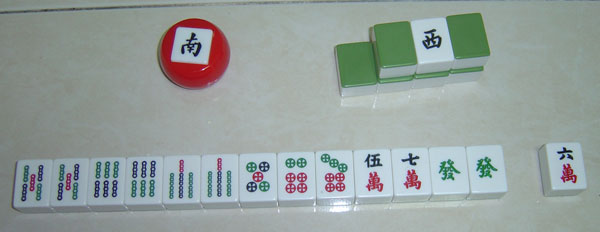
Round: South-4
Seat: North
Lucky Dragon: 1-Bamboos
We have the most points. It's the 6th draw of the hand


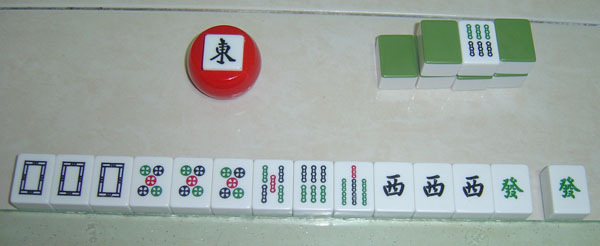
Round: East-1
Seat: East
Lucky Dragon: 8-Grands
Our turn as dealer on the 5th draw of the hand


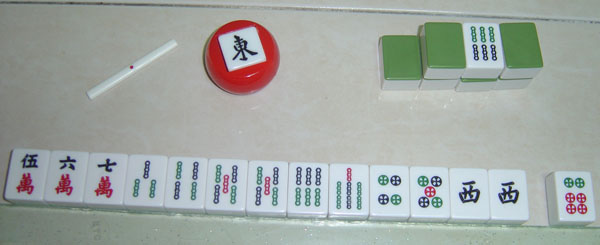
Round: South-3
Seat: South
Lucky Dragon: North-Wind
3000 points out of 1st place on the 12th draw of the hand

Thursday, July 26, 2007

Gemma's Journal #13

July 26, 2007


Gemma's Journal #13


So this will be my final scoring post - Answers to the last post!
Unfortunately this has required a lot (probably too much) thinking on my part!


Remember to work out the hand points first and then if it’s less than four you’ll have to work out the troublesome base points!


(Also I think I’m using a slightly simplified scoring table for beginners.)


Question One


Seat = East


Self Drawn


Hand points


One for double run
Two for three coloured run
One for closed self draw


Total = 4


Hurrah no need to count base points!


12,000


Question Two


Seat = North


Won off of someone else's discard


Hand points


One drag
One set of dragons
Two for three concealed Trips


Total = Four hand points


Hurrah! We don’t have to work out base points!


8,000


Question Three


Seat = South


Won off of someone else's discard


(In this one I didn’t show the hidden drag… oops! Let’s just pretend we weren’t using that rule!


Hand points


One for Peace hand
One drag
One for reach


Total = 3 hand points


We don’t have to work out base points for a peace hand either (hurrah!) so 3,900


That was quite sneaky of me to construct hands that didn’t use base points. (I did intend for Question One to need base points but I managed to construct a much better hand than I had intended originally.


I hope I got those correct! Someone should check for me! (^v^)


Another short post! Jenn and Garthe are really upstaging me. I have a fantastic post planned next. Well… when I say fantastic I mean fantastic if you, like me, HATE the all-pair hand. I want to take a closer look at it and see all the things I manage to do wrong with it. So start thinking about the strategies you have for the all-pair hand and hopefully we can have a discussion.


Also, if you’re not already registered on yakitori.com/, go and do so right this second! Been having great fun with the people over there discussing Mahjong and they’re so friendly, even to foolish beginners like myself, so please come and join in the fun!

Wednesday, July 11, 2007

Jenn's Corner #14: Playing in the World Series of Mahjong

July 11, 2007


Jenn's Corner #14: Playing in the World Series of Mahjong


I went to Macau last month as a member of the press, planning to cover this inaugural event for ReachMahjong.com and ended up the only American female to play in the competition. I didn't know until the night before that I would be able to compete, so I had not learned the rules as thoroughly as I would have liked to. I had read a brief summary on WSOM's website before going, so I knew that many of the hands were the same as in Reach Mahjong, but the scoring was quite different. I spent the entire night before the first round memorizing the hands and scoring, grateful that we would be allowed to keep a card of hands on the table while playing.


There were a few differences to get used to. For example, the traditional pattern of the Peace Hand (All Sequences) is ignored for simplicity. The Peace Hand in Reach Mahjong has no Base Points. That is why it must be an open-wait with no Value Tiles. If the pair was a Value Tile or the wait was closed, the hand would be worth 2 Base Points, and therefore not qualify as the Peace Hand. Differences like this are easily adaptable, so I woke with a tad bit of confidence and a lot of excitement.


Scanning in for the first session with Sayaka Yokoyama behind me


I arrived at the Wynn on the first day, armed with my official WSOM bag containing a calculator, pen, rule book, set of scorecards and stick for straightening the tiles. It would be the first tournament I would ever play without automatic tables.


My first game went slowly at first. The WSOM used Alan Kwan's Zung Jung Mahjong Scoring System. At first glance on the WSOM website, I thought it looked like a good combination of Reach and Chinese Official rules. However, in the first game, it was obvious that the rules as they were relied more on luck than both of the others and are very rewarding to beginning players and lucky players while penalizing experienced players.


The first thing I noticed is that most players go for the fastest hand. While this may be a good strategy, it becomes nearly impossible for players to aim for large hands. The only way players may get high-scoring hands is if they are very lucky with their starting tiles or lucky enough that the players going for the chicken hand (pointless hand) can't find their last tile. I ended up getting lucky in the first game by drawing the final 6-grand to finish my Full Straight, a huge win in these rules (40p each for 120p) and getting first place in the game. After that, I couldn't get lucky anymore and my points slowly dwindled down. By the end of the first round, with the afternoon session still to come, I figured I had to get a big hand or have no chance and I just couldn't get lucky. I ended with close to negative 300 points.


Miraculously, there were few enough players that I somehow made it to the second round the next morning. We each carried 1/4 of our total score to the next round, which meant if I could win just one big hand, I could stay in the game. I got lucky again and made it to the 3rd round. With only 16 hands in each round and people constantly winning with very cheap hands, only luck would save me in the 3rd round and it just wasn't in the tiles. I lost 2 games in a row and ended in 114th place.


One of the biggest advantages for inexperienced players in these rules is the payout scheme. To give you an idea of what I mean, here is a summary: All Sequences is worth 15 points, a set of Value Tiles is worth 30 points and a Full Straight is worth 120 points. All points are divided equally among players for self-draws, so All Sequences would be 5 points from each player. Here is where weak players are saved: A player who discards a winning tile is only responsible for other players' prices over 30 points. That means that if I discard the Red Dragon and a player wins on that, with the Red Dragon, each player must still pay 10 points. It doesn't sound like much, but most winning hands are only 10-15 points and there are a lot of hands won with zero points (chicken hand) so players that can read the board well ended up paying for others mistakes more often than not. This also increases the luck factor since it no longer makes sense to try to read the board and keep your opponents from winning. The option to “Fold” your hand is lost and so is a powerful tool for players that can read others' hands.


The lack of the Missed Win rule is another thing that is hard to get used to. While it can be a powerful tool in a game where players fold their hands, with the payout scheme in this system, it is almost impossible to justify folding your hand (although I tried a lot) and therefore makes the missing Missed Win rule another big advantage for weak players. A player that cannot envision the future of their own hand or plan for certain draws may get lucky and be able to win off of others' discards, even if he has thrown the discarded tile himself.


My final gripe was the prize structure. While most poker tournaments give 1st place 30% or less of the prize pool, this tournament awarded 50% to 1st place and skewing each prize dramatically down to 32nd place. I would have liked to see the players that made it to 32nd place get a bit more than just their buy-in returned.


I know it sounds like I'm just complaining about the rules as they stand now, but the event was a great success overall. It is because it was a success and I hope that it continues and gets better every year that I state my opinions here. There were nearly 300 competitors fighting for the $500,000 first prize! The games were played by the hand (8 hands for each game) and no bonuses were given for placing higher at the table. I liked this system a lot because it was based on points earned instead of lucky timing. The scorecards made for simple calculations and help the games move along very quickly. The media coverage was amazing with news teams from all over the world and representatives from newspapers, magazines and websites.


I had an amazing time and the team that made this event happen is an incredible group of people. They put on a great tournament and boy did they have guts to be the first to actually pull of a big cash Mahjong tournament like this! I think we can expect great things for next year's tournament and the years to come after that. Personally, I hope that they will consider adding events, like maybe a $1,000 buy-in Reach event added to the agenda? Maybe our buddies at Yakitori Online can help us send some persuasive messages (^.^)

Thursday, July 05, 2007

In Garthe's Hands #13

July 6, 2007


In Garthe's Hands #13


Let's have some fun today. Well, dream a little anyway. I've covered nearly all the hands in Reach Mahjong at least once now and that includes the vast majority of the hands that you will ever see in your Mahjong careers even if you should decide to play 20 hours a day for the next 10 years. Limit hands are like Straight Flushes in Poker: they only happen once every few thousand hands or so (OK, I picked that number out of a nether area, anyone have an exact number?), but they're still fun to think about and even go for when opportnity knocks. Taking a look at my Fight Club statistics, the only sort of extensive statistics I have, I've played 359 "Competition Rules" games which probably average around 10-12 hands per game for a total of around say 4000 hands; in all of that, I have a grand total of 3 limit hands, Big Dragons twice and 4 Concealed Triples once. I've played 1501 East Round games which probably average between 5 and 6 hands per game and in that total of say 8000 hands again there are only 3 Limit hands, this time all 13 Orphans. So those 3 are the types of limit hands that actually do come out on occasion. Today, I figured I'd introduce a few so rare I've never actually even seen them: 9 Treasures, All Green, and Big Wheels.


9 Treasures: Limit Hand


9 Treasures is known as Chu-ren-poh-toh in Japanese and it's so rare that it's rumored to be a harbinger of impending death. It's like a Full Flush except that specific tiles are required for it to qualify. The winning combination will be 1112345678999 and one more of any of them. The thing that makes this hand so devilishly impossible as that it must be concealed. (Sidenote: you may notice that if you miraculously get to ready with the very combination above, it's a dream 9 tile wait and this will be a double limit hand in places that allow such things.) And to make it more confoundingly impossible, it's also the kind of hand which falls into the Missed Win trap when unneeded tiles come and complete a normal Full Flush hand but not this special flush. Or before Missed win even becomes an issue, sometimes after 5 or 6 draws in a hand, I'll notice I'm only a few tiles away with a combination like 1112356779 and then check the board and notice that there are already 2 9's on the table so the chance for it is already past. It's the kind of hand that's fun to dream about and then come back down to earth and just go for the Full Flush with maybe a Full Straight for a few more points.
Not only have i never seen it finished, I've only ever seen it ready a total of one time also. And of course that one time it was a victim of the Missed Win, though not maybe for the usual reasons. My starting tiles in that hand were a lot of 1's and 9's with a 123 of grands in there also leading me to believe it would be a good chance to go for an outside hand so my first discard was the 6 of Grands. But before I could really get started, some jerk called Reach on about the 4th draw, and it just seemed best to give up the hand. As he kept drawing and not winning I was was happily discarding the Dots and Bamboos that he kept throwing away. Without noticing, I was collecting a lot of Grands and around the 11th round I looked down to see quite a few Grands. Sure enough, after putting things in order I had 1112345777899 and some blank to be one away from ready. The 9 came on the next draw but what should my wait be but that "#$!$%&#" 6 of Grands I had thrown on the first draw. The hand ended without anyone winning, and I got all kinds of advice on how better I might have played the hand. Well, maybe that's why I wasn't struck by lightning and am still here today.


All Green: Limit Hand


Next let's look at All Green. It's another one requiring a very specific bunch of tiles which is what makes it so rare and also so prone to Missed Win woes. It's called Ryu-i-sou in Japanese and both names mean what they say, the hand only contains tiles that are entirely green. Those would be the Green Dragons (Hatsu) and the 23468 of Bamboos. I must admit I was a little slow in noticing this, but it's true, 1579 of bamboos do have a bit of red on them which is why they don't get to be a part of ALL Green. In fact, with the Green Dragon being nicknamed "a-o" (pronounced "ow") which means blue in Japanese, sometimes I wonder why it gets to be included. There's a weird confusion of blue and green in this country: traffic lights are allegedly red yellow and blue; "blue onions" are green, fruit that's not ripe is "blue"; but maybe that's a discussion for another website. Anyway, some rules will allow All Green without any Green Dragons but most rules require at least 2 for a head though a triple is acceptable also. The remaining groups can be any pair run or triple of 23468 of Bamboos. Of course, runs will only be possible with the 234 and this is where Missed Win rears its ugly head again. Once again, the one time that I've seen someone get this hand to ready, he also had fallen victim by throwing away a 5 when his wait was the 2-5 of bamboos. Because of that 5 his winning 2 was discarded twice but he couldn't win on them because he had discarded one of his winners. This hand is the only one I'm introducing today that doesn't need to be concealed, but somehow that doesn't seem to make it occur any more reguarly. Once again, stories about it tend to be fish tales about the one that got away.


Big Wheels: Limit Hand


Finally we have Big Wheels. It's called Dai-sha-rin in Japanese, and it rounds out today's frivolity by being so rare as to not even be included in most rules. I write about it because a lot of home games do like to include it though it occurs even less often than the other 2 I talked about today. It's a pair each of the 2 through 8 of dots and in keeping with the theme of impossibility, it must be concealed. Also in keeping with today's theme, because it's all one suit like the others, it shares the same tendency towards Missed Win discontent. It's almost not necessary to make it a limit hand because as is, it's probably almost already that many points anyway. Consider that Concealed Full Flush, 2 Double Runs and Simples are guaranteed to be part of the hand with also a possibility of Peace, Reach, Concealed Self Draw and even Lucky Drags. 13 hand points would make it a "Counted Limit Hand" but I'll leave that as the subject for another frivolous column.


You may notice that all of today's hands are some variation on the flush theme. I've heard that these hands used to be divided along suit lines, i.e., 9 Gates had to be Grands, Big Wheels had to be Dots, and All Green had to be Bamboos. I'm just guessing but given the ludicrous impossibility of Big Wheels, somewhere along the line people may have decided to just go with the only ridiculous impossibility of 9 Treasures and changed it so that it was acceptable in any suit. All Green's name was just too suit specific to allow it to use other suits however. They're stilll fairly valuable hands even if one goes for the cheaper options, Full or Half Flushes. In most cases though, I imagine it'll be fun to try going for the glory for a few draws until it becomes obvious that cheaper is the only option. Just like in Poker, it's more fun to win with a Straight Flush and it makes a better story, but a simple straight may get the job done just as well. But every thousand hands or so.....let's look at some examples.


9 Treasures


It's a limit hand!! That means 32,000 points or 48,000 for the dealer. Of course, there are other winning tiles here. Can anyone take a shot at guessing the other winners and how much they'd score?


All Green


Once again, a limit hand!! No computation necessary, 32,000 points or 48,000 for the dealer. Here again the wait is tricky. Both the 2 and 8 still qualify as limit hands but winning on the 5 would just make it a Half Flush and Value Tile hand for a total of 3 hand points and 3900 points or 5800 for the dealer.


Big Wheels


A limit hand is a limit hand, 32,000 or 48,000 for the dealer. Even in situations where this is not allowed as a limit hand, it's still a knee slapper. Anyone want to take a shot at scoring it regularly? Just a little hint: I seperated the tiles that way to confuse you.

Friday, June 29, 2007

Gemma's Journal #12

June 29, 2007


Gemma's Journal #12


After last entries disaster I am back and this time better prepared! I hope everyone forgives me!


Here is the new questions:


Question One


Seat = East


Self Drawn


Question Two


Seat = North


Won off of someone else's discard


Question Three


Seat = South


Won off of someone else's discard


I hope I remembered everything this time! Also, I'd like to apologise for the delay in emailing! For some reason my internet here has been terrible over the last
week.


Looking forward to seeing if all our answers match! Happy Playing!

Wednesday, June 13, 2007

Jenn's Corner #13

June 13, 2007


Jenn's Corner #13


Another pictureless, but not an imageless column.

First, updates, since that is my job


Ron2 translation is finished, waiting for administration to get the thing into action. I know everyone is excited and waiting for it, so I’m really trying to push them as hard as I can, but they’re tough!


Next, website. I have been working really hard on the Hand List. Keep in mind that while the list IS complete, the images are NOT complete. I am updating the images on the road, so until I am finished (by the weekend I hope), some images will be incorrect. As it stands now, the images for the 1 HP hands are all correct. I will work on the 2 HP hands today and tomorrow and hopefully finish up the rest this weekend.


There is a new international online Reach Mahjong community! There has always been a forum on our website (here), but it is rarely used. I would like to encourage everyone to join in the discussions at Yakitori Online!

It is well organized and nice to look at. I hope it will become bustling with activity very soon! Looks like we are making more and more Reach friends all over the world.


OK, now on to even more fun stuff. I am writing this from Hong Kong and tomorrow I will be moving on to Macau for the first World Series of Mahjong tournament at the Wynn.

Tomorrow I will be practicing the rules and from the 15th-17th I will be watching this $5,000 (USD) buy-in event. The prize purse is promised to be $1,000,000 with $500,000 for first place. While this is not a Reach event, the rules hold many similarities to Reach. There are about the same amount of hands, but the scoring system is closer to the Chinese Official rules. I will have some Reach friends working both in the administrative department and also competing in the event. Look forward to a full report next week after the event!


I will probably write that in London when I stopover for one night on my way to the Open European Mahjong Championship in Copenhagen! That’s right, once again, a Reach-less event, but still very exciting because it looks like anyone who is anyone in Mahjong in Europe will be attending along with representatives from countries all over the world! I’m so excited I can hardly keep from typing in CAPS! This will also be my first time to Europe, so I am excited about that as well.


After these events are finished (and I do hope that some of my friends in these places will be up for some private Reach games as well!), I will be going to Italy, visiting Florence and hopefully some other areas to relax a bit before I’m back to Tokyo playing Mahjong everyday! Don’t worry, I’m practicing on the road too with Ron2 and I promise to keep the site updated. I made sure to stay almost exclusively in hotels with good internet access.


Vegas, Hong Kong, Europe, I’m starting to sound like a nomad… But I guess Mahjong journeys could never be a bad thing...
If any of you are in Hong Kong, the UK, Denmark or Italy, please e-mail me. I would love to meet and talk about Reach, Mahjong, the world, etc.!

Saturday, June 02, 2007

In Garthe's Hands #12

June 2, 2007


In Garthe's Hands #12


We have a request!! One faithful reader has expressed an interest in hands that are not "hands". Most of the hands I've covered so far involve some specific combination of triples and runs. However, some of the hands are situational, the triples and runs are not as important as what has the current situation in the game. I've covered a couple such hands so far, Reach and Concealed Self Draw. Remember, in both of these hands, the combination of runs and triples in the hand is not important, the hand must simply be "ready". One might consider these hands that are not "hands" because there's no specific combination necessary. There are several such hands but aside from the two mentioned above, they are comparatively rare. This week I'll cover 3 of the more unusual ones, Final Tile Win, King's Tile Draw (Quad Heaven Draw), and Add-a-Quad Win.


Final Tile Win: 1 Hand Point


Of the 3 hands this week Final Tile Win will probably be the most common (Haitei in Japanese). It is sometimes divided into two categories: Final Draw and Final Discard. Like Reach, the only requirement of the contents of the hand is that it be "Ready". The situation is that it is the last tile of the hand. This means that if the last tile drawn completes that player's hand, he can declare Mahjong, even if he didn't have any other Hand Points in the hand (Final Draw). Even if that last player to draw doesn't complete his hand, the last tile he now throws away is just as important. If that tile complete's one of the other players' hands then that player can now go out, even if he didn't have any other Hand Points in his hand up until that point (Final Discard). Of course, it will work together in the usual way with other hands to make for a multi-point hand if there are other points in the hand. Also, players will sometimes steal tiles toward the end of a hand to make their hands ready in case that hand ends in a draw. It can be a nice extra bonus to win on the Last Tile even though one was only going for the ready hand points.


A key point to be careful of with Last Tile is to not run afoul of the Missed Win rule. When that last player discarding is looking for something to throw away, he will often choose something related to a tile that was just discarded. For example, let's say I'm waiting for the 6-9 of dots with a ready hand that doesn't have any Hand Points in it yet. The second to last player discards my 6 of dots but I can't win on it because I haven't Reached, and I don't have any other points in my hand. Because he has just thrown the 6, the last discarder knows that it's a safe tile and unfortunately for me when he throws it, I still can't go out because I am now on a Missed Win. In fact, even if he had thrown the 9, my wait still leaves me subject to the Missed Win rule and would not be able to win on that tile either. Never forget the treachery of the Missed Win; it killed me more than a few times in my early days. Last Tile is unusual, but it's also a cool way to turn what might have been only 1000 points for a ready hand, into a few more for a winning hand.


King's Tile Draw (Quad Heaven Draw): 1 Hand Point


Next let's look at the Quad Heaven Draw. Once again, the only requirement for the hand's contents is that it be Ready. The situation is that a player has just completed a quad and the extra tile drawn from "Heaven" completes his hand. It's fairly simple actually, but some parlors have a special rule regarding this situation that I really REALLY hate, mostly I suppose, because I'm the only person I know to have ever been hit by it. If the player draws the tile to complete his quad himself, then it won't be an issue; the other 3 players will split the points to paid to the winner in the normal manner. However, if I throw the tile that completes a player's quad and the supplement tile that he draws from the King's Tiles is his winning tile, I am "Responsible", and I must pay the entire amount, even though I didn't throw his winning tile. It really ires me not only because I don't see why I should be paying when I didn't throw his winner, but it also takes precedence over the Missed Win rule which is usually one of the most sacred parts of Reach Mahjong. That player had actually thrown away one of his winning tiles and then drew it from Heaven and then I have to pay?!?!?!?!?!?! !"#$%&$%&'%&'($&'"#$%"%&$()%' Graceful loser that I am I may have lost some face with the staff on that one.


A note from Jenn: The reasoning behind this "Pow" or "Responsibility" rule (also seen in some Limit Hands) is that if you discard a tile that allows another player to declare a Quad, it means you threw a tile that has not yet been seen on the board and you should have an idea that it is quite dangerous. I'm not sure how I feel about this rule either, but there does seem to be some rhyme behind it.


Add-a-Quad Win (Robbing the Quad): 1 Hand Point


And last for this week will be the Add-a-Quad Win. Rarer in fact than some of the limit hands I wouldn't be surprised if many readers never get a chance to see it. The situation required here is that a player has bumped some triple and then draws the 4th of that tile to complete the quad. If he adds the tile to make his quad, and that tile completes another player's ready hand that player wins; the player making the quad must pay the winner. In general, concealed quads are exempt, though there is one situation where one can win even when the quad is concealed. When the winning hand is 13 Orphans, most parlors and home rules allow a win even when the quad is entirely self-drawn or concealed.


Because these hands involve situations and not combinations, it will be difficult to make very illustrative examples. But it just feels so empty without examples so let me go ahead and try anway:


Final Draw


The last tile drawn from the mountain was the 2 of Bams so the hand has Concealed Self Draw and Final Draw for a total of 500/1000 if it's non-dealer, or 1000 from each player if the winner is the dealer.

Final Discard


The player drawing the last tile from the mountain discarded the 8 of Bams and 9 of Dots was the Lucky dragon so the total is 2000 for a non dealer or 2900 if the winner is the dealer.

King's Tile Win


The 1 of Bams was the Lucky dragon so the player bumped hoping to get an outside hand. Unfortunately the 6 of Grands came so he was hoping to draw a 九 so he could change it to an outside hand but when the 9 of Dots came out, he quadded hoping to get lucky and he did!!! After quadding, he drew the matching tile for his head and gets one point for the King's Tile Draw and 3 more for the Lucky Dragons for a total of 4 hand points. That's 8000 for a non-dealer or 12000 for a dealer.

Add-a-Quad Win


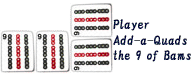
A player had already bumped the 9 of Bams and when he drew the last 9 of Bams and added to the other 3 to make a quad, this hand won. Peace, 3 Colored Runs (concealed) and Quad Heaven Draw for 7700 points for a non-dealer or 11600 for the dealer.

Monday, May 21, 2007

Gemma's Journal #11

May 21, 2007


Gemma's Journal #11


Hello again! Well finally lots of exercises for you to try out your new scoring skills. I decided to take pictures this time because I fancied getting up from my desk for a while. To be honest I haven’t yet worked out the points myself yet so I shall be doing it at the same time as you. I’ll post up my answers later this week and then Jenn and Garthe can publicly humiliate/encourage me!


As always I love emails so please let me know any interesting Mahjong stories that you might have or anything you think might be interesting to mention!

Saturday, May 12, 2007

Jenn's Corner #12

May 12, 2007


Jenn's Corner #12: Simple Update


As updates to the page have slowed down a little bit, our pace in the columns section has seemed to slow a bit too. I'm trying to stay on everyone's cases, but I suppose it is inevitable with a staff (are non-paid members still considered staff?) as small as ours that things will start to take more time. That is not to say, however, that we are all not still working hard everyday to get Reach Mahjong out in the world and in English.


I am always searching out and creating updates for the Glossary, which I have Garthe and Gemma check before I post. Expect another update coming soon and the one after that is already in the works. I understand that there are a lot of people who play Reach Mahjong that already know most of the terms for the game in Japanese. I think, however, that for new players coming in, it is easier to remember how to play a game if you don't have to learn an entire new vocabulary, so we are making appropriate English terms for each word. It might be a little tiresome for long-time players, so I encourage you to use whichever words are comfortable for you, as you have been, in comments and postings. If you feel like you can take a go at the English words too, more power to you. If anyone has questions, we will soon have the cross-referenced glossary up as well (Japanese->English), so it should be easy for anyone to look up an unfamiliar term and associate it to the tongue you know.


I know everyone is waiting for the RonRon translation. I am as well. It is a huge task and I will continue to mention it in every column until it is ready! Someone keep track!


The biggest happening in JPML last month was definitely the Masters tournament. Garthe was able to make it back to Tokyo for the event and advanced as far as the main event, but I was stuck in the U.S. and had to opt-out this year. This weekend is the 2nd session of JPML's regular league, so I am planning on increasing my current 7.9 point score. Garthe will try to sweep up to the black from the penalty I mentioned last time.


Later this month is JPML's 10-Tier Tournament.

I'm sure that some savvy readers out there know about the "Dan" or level system in many Japanese sports and games. JPML has this as well. As Garthe and I are still new to the league, we are the 1st Level, or "ShoDan". The highest level is 9. In the Tokyo branch of JPML, there are currently six Level 9, three Level 8, three Level 7, 5 Level 6, six Level 5, twenty-four Level 4, 33 Level 3, 52 Level 2 and 106 First-Level members. There is one more Level 9 member up in Hokkaido. Every 6 months, players are allowed to move up a level if they have earned enough "Level Points" by participating in and showing good performance in tournaments. The levels are supposed to represent skill, dedication, pride and status.

JPML's 10-Tier Tournament starts out with the First-Levels. There are so many this year, that there will be 2 First-Level sessions on May 19th. Each player plays 4 games at the same table. After 4 games, the 2 players that have earned the most points will advance and the other 2 players will be eliminated. The remaining players join the Level 2 players in the afternoon and the same system is invoked. The 2 people from each table that advance after that will join the Level 3 and Level 4 players on the 20th, and the winners from there will play in June with the higher Levels. This is obviously a JPML member-only and it is quite grueling with the semi-finals in July and then the finals in August.


JPML's second Womens League season starts this month as well. I will be participating even though I will have to miss one session in June so that I can go watch the European Open in Denmark (I will not be participating).


This turned out to be a very boring column, but check out Michi Yuuki's interview on our website! That has got to be a lot more interesting!

Sunday, May 06, 2007

In Garthe's Hands #11

May 6, 2007


In Garthe's Hands #11


Today I think I'll write a letter to myself. We've covered a lot of hands so far. There are only about 10 or so I haven't told you about yet, and for the most part, they will probably not figure largely in your Mahjong careers. So today in light of some recent events, I thought I'd review a couple hands that are comparatively rare but will still be relevant to your Mahjong conquering dreams. At least, one would have been relevant to my dreams had it come to mind at the right moment. How about another look at the two outside hands using some recent real life examples.


Let's begin with the Pure Outside hand, known as "Junchan" in Japanese. Every group must contain a 1 or 9, meaning that only triples of 1's and 9's, and runs beginning with 1 or ending with 9 will be in the hand. It will never contain any honor tiles, and will not use the numbers 4, 5 or 6 in any suit. It is 3 hand points when concealed, and 2 hand points when tiles are bumped or chowed. This is a fairly difficult hand to put together so parts of it will often be exposed like in today's example. There are many ways to make this into a high scoring hand, but today's is one that might not have occurred to a lot of players. It's also a good example of how remaining flexible throughout the hand can help you change course and still pull off a nice winner when you run aground on your first course.


My friend's starting tiles and first draw looked about like this:


It's not a great starting hand, and with 9 different outside tiles, it actually qualifies as a hand that you can say "I give up" and make everyone start the hand over. My friends however, ever the dreamers, never give up a chance at a limit hand, and so off this guy went on a quest for 13 Orphans. After 7 or 8 draws, he had only managed to exchange a couple of the middle tiles and was not any closer at all to assembling the orphans, especially after I'd bumped 3 of the White Dragons. His hand now looked like this:


This hardly looks promising, but 1 of Dots was the Lucky Dragon and when the player in front him threw 8 of Grands he suddenly chowed and decided to go for an Outside hand. Next he drew 8 of Dots and with more cooperation from the player before, he chowed 7 of Dots from him and was now only one away from ready. That player next called Reach, discarding the Lucky Dragon which our hero bumped, and what was his next draw but his winning 7! His winning hand:


Pure Outside Hand(exposed), 3 colored runs (exposed) and 3 Lucky Dragons, was good for 12,000 points. Sure it was a lucky crazy move, but then that's what these games are, putting yourself in a position to get lucky.


Next let's look at an example where I put myself in fantastic position to get lucky and blew it with Mixed Outside hand. To review, this hand is like the Pure Outside hand except that it allows the use of Honor tiles. Concealed it's 2 points but exposed it will be worth just 1. I had had a pretty tough first 3 games at Masters last Saturday and needed a big win in the final game if I wanted to continue onto the next round. We were getting toward the end of the South round of the final game and my last turn as dealer had just been stolen on a 1000 point hand. A little despondent, I felt more like disrupting everyone else's game at that point than trying to win. I started with:


and bumped the White Dragon my first chance when it came out first round. The next round someone threw the South Wind and right away things are starting to look interesting, especially when I draw the West Wind to make a Head. Now I'm now only one tile away from completing this Half Flush hand with two Value tiles, that's 8000 points and gives me a shot at finishing the day in the black and going on to the next round. At some point here, it would have been good for me to notice that the hand also included the Mixed Outside hand, even though for the moment, the five hand points still only make it an 8000 point hand. The defining moment was when the player before me reached and I drew the last South Wind to make a quad. Not only was the "King's Tile" the 3 of Dots but it was also the "New Lucky Dragon" giving me one more point and bumping my hand up to 12,000 points. The Reacher threw my winner on his next draw but without thinking, I just said 8000 points and that missing 4000 would prove to be what kept me from advancing. I finished with -1900, and the cut off was -300.


So not only is an awful story because I didn't advance, but also I know all the guys I work with can't wait to start teasing me about how I could advance in tournaments if only I knew how to keep score. Add to that the fact that I threw an 18,000 point winner to one of the guys I work with when we happened to be at the same table, and the fact that I will undoubtedly make this very kind of mistake again, and....sigh. Well it's enough to drive a boy to Poker. So let Mixed Outside hand never be far from your mind, especially when it is the deciding 4000 points for whether or not you're advancing to the next round in the biggest Mahjong tournment of the year.

Monday, April 30, 2007

Gemma's Journal #10

April 30, 2007


Gemma's Journal #10


A note from Jenn: This entry was supposed to be up a few days ago, but while in Vegas I had some technical difficulties. I'm back in Tokyo again, quite possibly for good. Stay tuned for more on-time updates!


Ok, so I'm hoping that everyone got what happened in the last post. I'm still not entirely sure of the whole scoring system myself so any encouragement is much appreciated! I'm hoping that the people I teach Mahjong to in Taiwan have been reading these too. Everytime I tell them how much a hand is worth they're completely incredulous and think I'm just making numbers up on the spot. Now I can prove to them that there is some logic in the seemingly random numbers I come up with!


So, you have your base points now hopefully! Where are we going to go from there?
You need your hand points! Garthe has been going through the hands and what each is worth, so hopefully you have a good idea how many hand points each hand is worth already. We then have to look at a chart (well beginners have to look at a chart and those of us who's brains are too tired from having to work out the base points already). The easiest thing that I have found is just learning the chart, although Jenn has kindly explained the whole thing to me. I did find it a lot easier to just pull the numbers from my memory than try and work the whole thing out mathematically each time. Also if you're not a genius then it's pretty difficult to work it out quick enough in a real game.


All the tables were automatic and quite frightening to the uninitiated. It took me a little while to get used to all the buttons and what they did; although it does speed up the process so much. I really appreciated not having to build the wall manually and not having to count the bones (They're counted automatically for you by magnets). So now I've decided that my new aim is to have one in my house (I have to get a house big enough for one first!).


I'm not going to swamp you with the entire chart now. I'm just going to give you the ones that are going to be the most useful (also seemingly the most random- if you can memorise these two charts the rest is a breeze!). Then, next week I'll give you the rest.


Non-Dealer

Top number is when won off a discard (one person pays). Brackets are for a self-drawn win- first number is what the non-dealers pay out and the second number is that which the dealer pays out (the bigger one!)


Hand Points ->

Base Points
123
301000
(300/500)
2000
(500/1000)
3900
(1000/2000)
401300
(400/700)
2600
(700/1300)
5200
(1300/2600)
501600
(400/800)
3200
(800/1600)
6400
(1600/3200)


Dealer

Top number is when won off a discard (one person pays). Bottom number is what each player pays the dealer for a self-drawn win.


Hand Points ->

Base Points
123
301500
(500)
2900
(1000)
5800
(2000)
402000
(700)
3900
(1300)
7700
(2600)
502400
(800)
4800
(1600)
9600
(3200)


At 4 hand points everything gets a lot simpler and base points cease to matter!


Non-dealer


4-5: 8000 (2000/4000)

6-7: 12000 (3000/6000)

8-10: 16000 (4000/8000)

11-: 24000 (6000/12000)

Full points (Limit Hand): 32000 (8000/16000)


Dealer


4-5: 12000 (4000)

6-7: 18000 (6000)

8-10: 24000 (8000)

11-: 36000 (12000)

Full points (Limit Hand): 48000 (16000)


So after three hand points things get a lot easier! So I would just remember that for the time being and those are the most common points to score.

However, one last annoying thing is that there is a different chart for All-pairs and Peace hand.


Non-Dealer


Hand Points ->

Base Points
1234
Peace1000
2000
(400/700)
3900
(700/1300)
7700
(1300/2600)
All-Pairs1600
(400/800)
3200
(800/1600)
6400
(1600/3200)


Dealer


Hand Points ->

Base Points
1234
Peace1500
2900
(700)
5800
(1300)
11600
(3900)
All-Pairs2400
(800)
4800
(1600)
9600
(3200)


After the 4 hand points it just starts to follow the 5 hand point values which makes things a lot better!


Put off now? I think I am! This is possibly not the most ideal way of explaining or teaching it so I think I might try it out on the people here and see if we can come up with a better way of explaining the whole thing. Next column I'll try and work through some examples and also post up the remaining charts for base points over 50. You'll have all the materials you need for scoring then and hopefully with a few examples the entire ordeal will be a lot clearer!


I took all the numbers for the charts from a book so if there are any mistakes I blame them, or my transcribing! Either way please post up so I can rectify the problem.


Finally, I shall leave you with a question. Why does Peace hand and All-pairs not follow the scoring system that uses the base points? I'll demand an answer from one of our pros if no one else knows!


Good luck going through these charts! And remember the best way to learn is practice! Set yourself questions, or even better make up a question and post it up here and have us all look at it and argue over it. You lot are probably helping me more than the other way round anyway!
Thank you for reading this far! Until next week!


And as usual every week I love to get emails and now that I'm home I have lots of time! So email me!

Saturday, April 14, 2007

In Garthe's Hands #10

April 15, 2007


In Garthe's Hands #10


Greetings from Vegas!! I'm working! And studying, compliments of Jenn, Kirk (poker buddy) and the rest of the Poker community at Bellagio and the MGM Grand. I have to say that in case any of you thought I was just out here fooling around. Unfortunately, work isn't paying so well this time around, but there are still some more work days ahead so we'll have to see. I'm always intrigued when I can make comparisons between ways to play things in Poker and Mahjong. I just hope all this Poker doesn't take me out of the zone when I'm playing Mahjong, I've been doing so well lately. Ha!


Last time I wrote, I promised the next hands you would see out of me would not be very useful, but maybe I'll put that off for another week. Before we delve into total obscurity, how about a couple hands that might actually still figure into your Mahjong futures? I've only given one column to limit hands so far so let me introduce another one that does come up sometimes along with its little brother.


Little Dragons: 4 Hand Points (2 for Little Dragons, 1 for each set of 3 Dragons)


Let's start off with Little Dragons. I've only seen it a few times, and have yet to see it on Fight Club, but when it hits, it can be a nice payoff. Called Shosangen in Japanese, it's worth two points whether or not any tiles have been bumped or chowed. One qualifies for this hand by getting 2 triples of any of the 3 Dragons and a head consisting of the third Dragon. The other two groups in the hand can be any runs or triples of any suit or honor tile. Because each of the Dragons will always count for a hand point, the hand will always be at least a 4 hand point hand. One of the ways to make it count for more is to mix in the Half Flush. This shouldn't be too difficult as more than half the hand is already given over to Honor tiles anyway. If the remaining two groups are the same suit or are honor tiles, it bumps the hand up to 6 hand points for a score of at least 12000/18000 points. However, the best way to get the most bang for your Dragon's buck is to go for this hand's big brother: Big Dragons.


Big Dragons: Limit Hand


The difference between Small Dragons and Big Dragons is all about one tile, but that one little tile makes all the difference in the world. While the Little version is just two of the triples, the Big version is triples of all three of the dragons. This is another limit hand (like 13 Orphans or 4 Concealed Triples) which means we'll get the most points possible no matter what else is in the hand, 32,000/48,000 points. Again, the remaining two groups can be any kind of run or triple. There's no restriction against bumping or chowing and indeed, it would be pretty difficult to assemble triples of all three dragons without at least one bump. And once that second Dragon has been bumped, suddenly everyone will be extremely wary of discarding any of the last remaining dragons. That last one will almost certainly need to be drawn though there are situations where it will sometimes come out, most notably when a player has reached and must discard anything that is not his winning (or a quad-able) tile. It is a sick feeling to have reached and then see someone bump the second dragon, especially if none of the third remaining dragons are on the table.


Because the Little version is so close to the large version, it's always a quandary deciding whether to go out on the cheap or go for the glory with the Big. It's not an issue if one has somehow managed to get to ready with triples of all three in the hand through bumping or even just drawing. However, the vast majority of the time, at least one or usually two of the dragons will have been bumped and our hero's ready hand will be waiting with two pairs, one of them being the last remaining dragon, and the other being some unrelated non-glorious nothing. If the nothing comes out first, what...do...you...do? Well, there are a lot of f>actors to consider: what everyone's scores are the moment, how early in the hand it is, whether or not someone has reached or stolen tiles so he seems close to going out, etc. Also sometimes people and Mahjong parlors play with an extra reward for finishing a limit hand, so that might also figure into the mix when deciding whether or not to continue trying for the limit hand even after a cheaper winning tile has come out. It's an extremely rare hand, of course, it's a limit hand! But it will spice up the game once in a while, even if someone only manages to finish with the Little version.

Here are some examples


Little Dragons ex.1


Let's say this is a river-win. Just the two value tiles (the White Dragon and Red Dragon), and Little Dragons for a total of 8000/12000 points. (Note that if the Blue Dragon was drawn or bumped, 8 of Dots or 9 of Dots could be discarded for a single tile wait and a chance at Big Dragons and a glorious earth shattering win)


Little Dragons ex.2


Blue Dragon, Red Dragon, Half Flush (concealed), 3 Concealed Triples, and Little Dragons for a total of 16000/24000 points


Big Dragons ex.1


Big Dragons, 32000/48000 points, no matter how you slice it. (You may notice that this hand is also actually a Mixed Outside hand, but it's already a limit hand so the point is MOOOOT)

Tuesday, April 10, 2007

Jenn's Corner #11

April 10, 2007


Jenn's Corner #11


Hello everyone! It's Jenn. I got tired of waiting for Garthe to write his column (he is currently in the US, working on some other stuff), so I will take his place and post his next column. I know you would rather read about me anyway (^.^)


So the new Mahjong year has started and there is a lot to look forward to this month! First of all, JPML's first League session of the year took place this past weekend and I finished in the black with 7.9 points, putting me in a tie for 31st place out of 71, so just 4 more sessions to stay ahead of the game if I want to move up a league next season. Garthe had to miss the first session and take a penalty, so he is in the red right now...

The first game I did horribly. I was not concentrating properly; I was playing my hands badly and worse, reading the board badly. I took a few minutes after the first game to reflect on my play and I was able to regroup and take 1st place in the next 2 games. I took a negative 2nd place in the 4th game, but it was enough to have the highest score at my table. About 20 people or so will move up from D2 to D1 this season, so if I can keep my composure for the rest of the season, I really do think that I have a chance this time!


The JPML League has 9 levels: A1, A2, B1, B2, C1, C2, C3, D1, and D2. Almost everyone starts at D2 and has to work their way up. You can only move up once each season for leagues B1-D2 and once a year for the A leagues. There are 2 seasons of 5 months each year. Garthe and I, starting last year, are still in D2 League. By normal routes, you can see that the quickest anyone could make it to A1 and a chance at winning the Phoenix Cup is 5 or 6 years. That's a long time for a good player to wait and not have any bad days... But, this year JPML announced a new special league to allow young players to move up faster, making the playing field more fair and competitive based on good performance.


JPML's Special Advancement League invites players under the age of 40 who have participated in JPML's 4 big tournaments (Pro League, Masters, 10-Tier and OUI) to fight for a spot in a higher League if they have: moved up one league by their own ability in the previous season, made it to the final table in Champion's League, got 1st or 2nd place in the annual Rookie Tourney, won the Pro Queen Tourney, made it to the final table in Masters, 10-Tier or OUI tournaments, or place first in a regional league. In addition, they must end in the black for the current League season and may not miss any League sessions for the current season.


It is a strict set of conditions, but for a chance to move up 5 levels or so it seems a small price to pay and many people are participating. So yes, I will also work to move up this season so that next season I might fight for a chance to up my status the "easy" way.


One of the biggest news items this month is that JPML tournaments are now all non-smoking. Or so it may seem... Actually, players currently involved in a game and spectators must refrain from smoking. Players in between games and players at tables that are finished with games are allowed to smoke to their hearts' content, so the parlor still ends up smoky. But, if a player wants to smoke between games, they must get permission from the other players at the table. I personally ask them to go outside (nicely of course)...


Also, Mahjong Fight Club 6 is finally in arcades all over Japan! You can check out the website (in Japanese) here and see pictures of Garthe and I here. The new version has added a Competition Rules option, so now players can play a more skill-based game using JPML's A-Rules. Just like the Pro League except for the dealer has to win a hand to continue as dealer and cannot continue if he has a Ready hand on a draw.


The Ron2 translation is coming along. Garthe and I are doing our part and are working hard with the administrator to get a game to you as soon as possible! I can't wait to see you all there!!


Now, I have to get ready for my own trip to Vegas to teach Mahjong and also work on my poker skills. If anyone will be in the Vegas area in the next 2 weeks, send me an e-mail and Garthe and I will be happy to set up a time to play Mahjong together!!


Now, just for kicks, here is a hand that I had during the 3rd game on Sunday:


The Drag is 8 of Bams. What would you discard and why? Also, after you discarded, what tiles would you be waiting for? As dealer, how many points is your hand worth on a river win? How about a self-draw? Do you think this hand is worth Reaching in a game with no First-turn win, Quad Drags or Hidden Drag bonuses?


To post comments to this column, click here.

Tuesday, April 03, 2007

Gemma's Journal #9

April 3, 2007


Gemma's Journal #9


Here it is, the first part of the series of entries on scoring that I've been putting off writing! This will probably go quite slowly for those already acquainted with the art of scoring in Japanese Mahjong. As you know, though, my entries have always been aimed for beginners by a complete beginner. I'm expecting that I'll make lots of mistakes over the next few weeks so I'll be expecting you experienced ones out there to be correcting me and cheering all the newbies on!


Scoring... once you've finally managed to commit all the hands to memory (I have to admit having a card in front of you with the hands on like they do in America does sound a little appealing from a beginners point of view!) scoring really is a bit of a kick in the teeth! I'm not going to lie but you're going to have to get memorising some more. There are a lot of points handed out for different things, I think it looks quite daunting but we can make it together! Good Luck everyone!


There are two kinds of points in Mahjong.

Hand points - the points associated with hands that Garthe has been introducing to us:


Base points - the points that you gather in other ways for having sets, certain waits, etc.


Base points is where I want to begin explaining. So how do you obtain these base points?


Mahjong

First things first, you get 20 points for going out. You then get an additional 10 points if you Mahjong off someone else's discard if your hand is concealed, to make 30 points. If you draw the winning tile yourself (concealed or not) you get 2 points, for 22.


Sets


32 points for a concealed quad of 1 , 9 or honor tiles

16 points for a concealed quad of 2 - 8


16 points for an open quad of 1-9 or honor tiles

8 points for an open quad of 2-8


8 points for a closed set of 1-9 or honor tiles

4 points for a closed set of 2-8


4 points for an open set of 1-9 or honor tiles

2 points for an open set of 2-8


Head


Head made of value tiles is 2 points

Anything else... 0 points!


Wait


Double sided wait = 0 points

Waiting to complete a set, e.g. 44 88 = 0 points

Middle wait e.g. 57 = 2 points

End wait e.g. 12 = 2 points

Waiting for the head = 2 points


It's not too horrific! I mean, sure, you have to memorise a lot, but at least they're all even! Imagine if it had been multiples of three! (you wouldn't think I had an A-level in Maths!)


Best way to memorise it though is, as always, practice! So with that here are some more puzzles for you. I want you to try and count up the base points. Perhaps I'll post up some more, later in the week, if I can get enough replies.


Self-Drawn


River Win (taken from another's discard)


East-Round

East Seat


River Win (taken from another's discard


And as usual every week I love to get emails and now that I'm home I have lots of time! So email me!


To post comments to this column, click here.